LPG has a compelling well-to-wake (WtW) carbon emissions profile and has emerged as the de facto fuel choice for VLGC newbuilds, according to a leading expert on gas fuels.
“LPG from a well-to-tank and well-to-wake perspective has the lowest carbon emission factors,” said Lloyd’s Register (LR) global gas markets & technology lead, Constantinos Chaelis.
To back his claim, Mr Chaelis shared data compiled by the class society during his presentation ‘Avoiding stranded assets: LPG as fuel and other options as mid-life strategies for LPG carriers to remain compliant & competitive’ during April’s Maritime Decarbonisation Conference, Asia. The data compared currently available fuels, including very-low sulphur fuel oil (VLSFO), marine gasoil (MGO), heavy fuel oil (HFO), LNG (combusted in a dual-fuel, Otto-cycle engine), LNG (combusted in a Diesel-cycle, dual-fuel engine) and LPG. Using MGO as the measurement baseline, LPG yielded CO2e savings of 17% — better than LNG (Diesel-cycle dual-fuel engine) at 16% or LNG (Otto-cycle, dual-fuel engine), 5%. The data combined well-to-tank GHG emissions, tank-to-well CO2 emissions and tank-to-well other GHG (CH4 and N2O) emissions.
Operating large non-gas carriers on LPG fuel “would be a challenge,” said Mr Chaelis, “as you would need to call at an LPG terminal.”
 Source: Lloyd’s Register, April 2023
LR is the leading class for VLGCs in service, with some 361 ships out of 1,598, and has secured almost a 26% market share of those on order at shipyards, according to data shared by Mr Chaelis.
The class society’s pioneering experience includes the first LPG dual-fuel VLGC newbuild delivered, Exmar’s 88,000-m3 Flanders Innovation, which was built to LR class at China’s Jiangnan Shipyard. Flanders Innovation and its sister, Flanders Pioneer, were delivered into a long-term charter with Equinor in 2021. Both gas carriers have two-stroke, Diesel-cycle dual-fuel MAN 6G60ME-C9.5-LGIP engines that reduce CO2 emissions by about 38% as compared to IMO reference lines for VLGCs.
“Over 90% of dual-fuel LPGs are very-large gas carriers”
Since early efforts by Exmar and BW LPG, which undertook a massive retrofit of its fleet, LPG shipowners have embraced dual-fuel propulsion.
“49 dual-fuel VLGCs are in service and 76 are on order,” noted Mr Chaelis, adding, “So, over 90% of dual-fuel LPGs are VLGCs.”
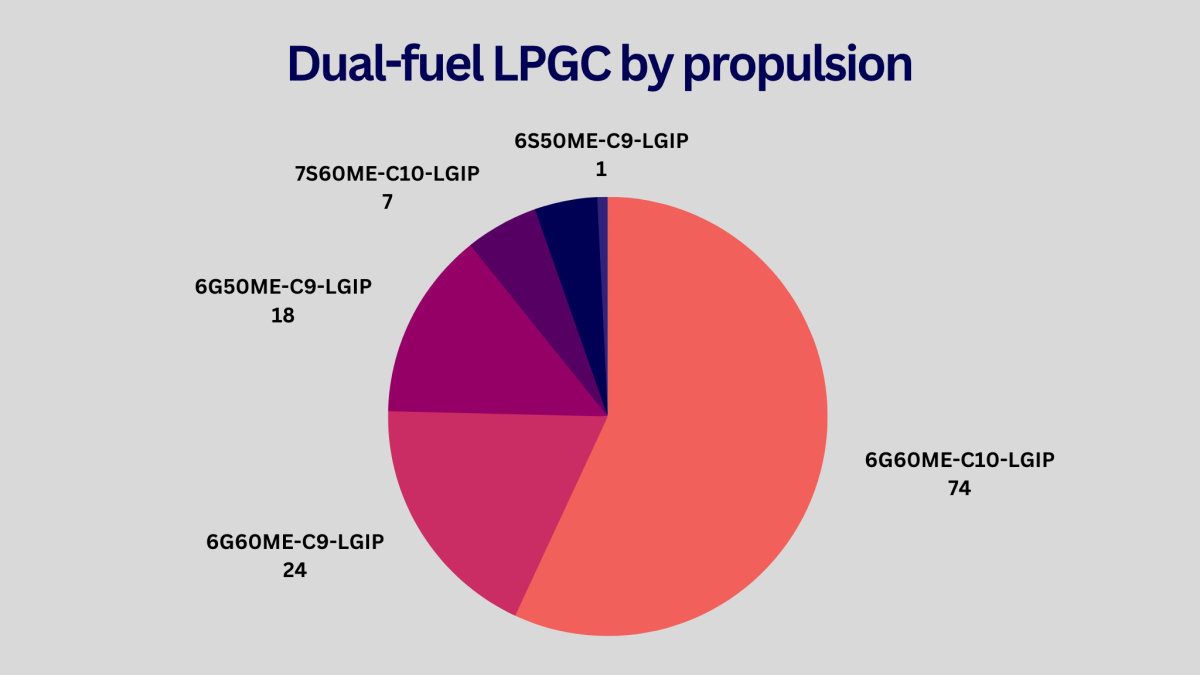
Data available for engine type for 131 LPG carriers presented by Mr Chaelis showed that 75, or 57%, had been equipped with MAN Energy Solutions’ LPG dual-fuel two-stroke 6G60ME-C10-LGIP engines.
LR is working with the World LPG Association to develop an LPG as fuel guide, and a case study detailing the LPG dual-fuel retrofit of a container ship that operates on a route around West Africa.